
Sameh
David Leaser - Fans of Gleannloch Arabians FB 2026
Sameh (El Moez x Sameera) 1945 Grey Stallion
Born at the famous Inshass Stud owned by King Farouk in Egypt, Sameh quickly made his mark as a superior stud. When King Farouk was deposed and the Inshass herd was disbursed, Sameh became a senior stallion for the Egyptian Agricultural Organization. During his life, Sameh sired about 55 offspring in Egypt, and a number were imported to the United States.
Most people are familiar with his National Champion daughter *Serenity Sonbolah and, of course, *Ibn Hafiza and *Sultann, who sired or grandsired national winners. But what about his daughters at Gleannloch? Gleannloch purchased several daughters directly from the EAO and also one (*Deenaa) from HJ Huebner, from whom the Marshalls also purchased *Bint Hanaa, *Gamilaa, *Sakr+++ and *Habeeba. The six Sameh daughters in the Gleannloch herd consist of the following, along with their offspring listed as bred by Gleannloch:
*SHAMAH (Sameh x Rafica)
- Amir Ibn Shamah (x*Morafic)
- Seif Al Nasr (x *Ibn Antar)
- Bint Shamah (x *Morafic)
- Bint Bint Rafica (x *Morafic)
- Salmah (x *Morafic)
*SAFAA (Sameh x Lubna)
- Muzahrafa+ (x *Morafic)
- Al Fattah (x *Morafic)
- Zaim (x *Morafic)
- Karim Ibn Safaa (x *Ibn Hafiza)
- Sheriaa (x *Ibn Hafiza)
- Mishmish (x *Morafic)
- Al Safi (x *Ibn Hafiza)
*ROMANAA II (Sameh x Nazeera)
- Dalia++ (x *Morafic)
- Bint Romanaa++ (x *Morafic)
- Gahlih (x *Morafic)
- Rabeeah (x *Sakr+++)
- Haround (x *Sakr+++)
- Fateen (x *Faleh++)
*OMAYMA (Sameh x Nazeera)
- Ramzy (x *Morafic)
- El Risaan (x *Morafic)
- Ohmyhssen (x Mohssen)
*FAWKIA++ (Sameh x Mamlouka)
- Farahl (x *Morafic)
- Najlah (x *Morafic)
- Ana Gayah (x *Morafic)
- Imperial Al Amaar (x Amaal)
*DEENAA (Sameh x Dahma II)
- Hanan++ (x *Morafic)
- Narimaan (x *Morafic)
- Ahir (x *Morafic)
- Imperial Fanniya (x *Faleh++)
==//==
In a different article, What Did Not Get Away? - Part 1 Musings on what still can be [Arabian Essence Newsletters 2022 ], Joe Ferriss writes of the "Ibn Rabdan Branch:
The older of the four key progenitors is Ibn Fayda who is very rich in the old Ali Pasha Sherif breeding. Ibn Fayda's patriarchy comes forward through the great stallion Sameh via 3 of his sons: Ibn Hafiza, Sultann and Aseel. All three of these were handsome horses of good body type and movement but of rather plain head. The hallmark of Ibn Rabdan breeding is often the beautiful body proportions, good length of neck, excellent shoulders, good depth of body, strong quarters, good legs and very good movement, but like Ibn Rabdan himself, the heads are not as beautiful as the Nazeer sire line. However the female lines play a role over time in improving the heads and when all else is maintained, the results are very good indeed. So considering a stallion of Ibn Rabdan's sire line as a kind of outcross makes more sense in today's pedigrees. One can choose the Ibn Rabdan sire line and have it both ways, quality and beauty."
More about Sameh by Joe Ferriss - Spring 1998 - Volume Fifteen, Number One Khamsat Magazine.
Samraa line…
Sameh, the Namesake 1945-1967
“I create thee, Arabian. To they forelock I bind good, on they back I set rich spoils. Imade they owner fond of you, and made they fly without wings” Allah
In Spring of 1945 in Egypt all was in bloom again and World War II was drawing to a close. A deep seal-brown foal was born with a star on his forehead and two white bind socks. Grey hairs were to emerge later making him in old age like a speckled piece of silver ivory. His birth place was the Royal stable at Inshass at inshass outside of Cairo, Egypt. The colt was named “Sameh”.
The colt must have met with everyone’s satisfaction as Sameh was retained by the Inshass stud and used for breeding. A short time later King Farouk abdicated his throne to defer power to the new president Gaml Abdel Nasser, ushering in an era which no longer had need of a Monarchy and the Inshass stud came to an end. Sameh survived this period siring a few foals for the Army and Police. Later many of the remaining Inshass horses were incorporated into the EAO, and of course Sameh was one of these.
A fair number of pictures have been taken of Sameh over the years, and from these one can see a handsome horse of gracefully flowing rounded lines, good length of proportion of all parts in relation to the whole, as if he were being formed in clay. He would have made a marvelous sculpture. His head was not extreme, but handsome, appropriately shaped and clean in appearance, with a kind expression. He has been described as a horse of powerful appearance, yet with grace, and quite clean boned. He had very smooth conformation and brilliant trotting action. Much of what made Sameh desirable as an individual seemed to come out in good measure in his get. Even in the changing times under which he spent his life in Egypt, Sameh got 53 recorded Arab foals, a respectable number under the circumstances.
Sameh is a grandson of El Samraa who founded a significate family in Egyptian breeding representing such notable as Al Metrabbi (*Morafic x *Sammara), *Zaghloul (Gassir x Gharbawia), El Hadiyyi (*Ansata Ibn Halima x *Sammara), and *Ibn Al Hassan (Hassan x *Bint Bint El Samraa).
By the late 1950s, the first of Sameh’s most notable get arrived in North America. In 1959, the bay colt *Ibn Hafiza was born out of the double Hamdan daughter, Hafiza. This horse was later to be retained by the EAO as one of the more important sons of Sameh, to represent him. After leaving a number sons and daughters at the EAO, *Ibn Hafiza was imported to the U.S. in 1970 by Douglas and Margaret Marshall. *Ibn Hafiza was one of few remaining Egyptians of his era without the blood of Blunt ancestral Element, making him a significant outcross in Egyptian breeding and a useful individual in the “sharps” breeding group as well. He was one of the last of the 100% Inshass horses surviving the dismantling of the Inshass stud. *Sultann (x Lubna) came to the U.S. shortly after *Ibn Hafiza and also made a notable contribution including his Nationals winning sons, *Sakr and *Asadd.
In time, Sameh became even more noted for the quality of his daughters. One of the most memorable of all of his daughters was the lovely *Serenity Sonbolah (x Bint Om El Saad), imported by Hansi Heck Melnyk, a splendid chestnut mare with captivating beauty. She became US National Champion Mare. Other daughters of Sameh imported to the US include: *Shamah (x Rafica), *Ansata Bint Sameh (Futna); *Ansata Bint Misr (x*Ansata Bint Bukra), *Romanaa II (x Nazeera) * Safaa (x Lubna), *Omayma (x Nazeera); *Fawkia (x Mamlouka), *Serentiy Bint Nadia (x Nadia [INS]), who was one of the last of Sameh’s daughters of 100% Inshass breeding. Sameh’s last daughter was the chestnut mare Ghada (x Zebeda), born in 1967. That same year at age 22, Sameh died at the EAO, and it would seem too soon for such a wonderful Arabian stallion. Because of his much admired influence, he lives on in many of his descendants we enjoy today. Born a drinker of changing winds, it can also be said that Sameh brought change to the winds of Egyptian breeding.
Ancestor of:
Agecroft Layla (Talika Farad x Talika Sirina bint Sirdahn)
Agecroft Ghayl (Greenmantle Ghashahn x Talika Sirina bint Sirdahn)
Khe Amin Tabou SSR (US) (Al Reyhan Marou x Anisa Gamal)
Ameer El Koloob (US) (Nour Al Kamar MH x DHS Tarah (IRE))
Ibb El Koloob (Ameer El Koloob (US) x Agecroft Layla)
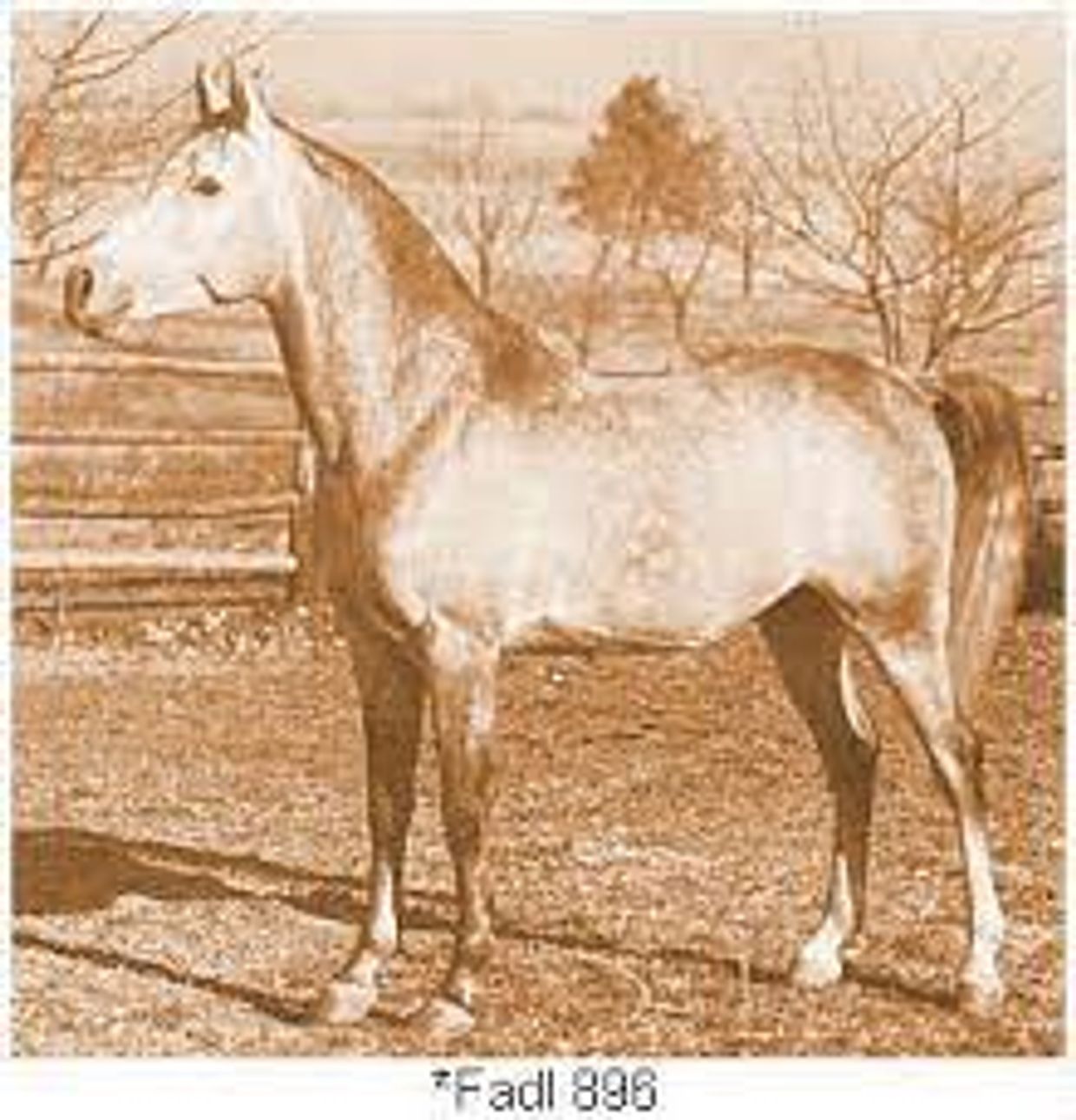
Fadl
Joe Ferriss' musings (2022)
Joe Ferriss, in his article "What did not get away Part 1 Musing on what still can be." [Arabian Essence Newsletter] writes: "Shahloul and Hamdan's three-quarter brother Fadl was the only straight Egyptian stallion which Mr. Babson began his Arabian breeding program in 1932. So all Egyptian stallions produced from the original Egyptian program of Mr. Babson were of the Ibn Rabdan sire line. Fadl actually had a huge impact on American breeding even more than within Egyptian lines, being the grandsire of the "fabulous Fadjur who was for many years in the 1950s through early 1970s the most heavily used sire in America. Three of Fadl's Egyptian sons have carried his sire line forward, Fa-Serr, Fabah and Lothar. These were very handsome horses found in many champions. One of the most handsome representatives of the Ibn Rabdan sire line at Babson's and a horse who looked very much like Ibn Rabdan was the liver chestnut stallion Serr Rou (Ibn Fa-Serr x Bahrou) a grandson of Fa-Serr and Fabah. Lothar was a horse I knew personally and he was a very typy and refined chestnut roan horse who was the vision of old 19th century engravings. The Babson horses have continued to be a consistent source of the Ibn Rabdan sire line and have long proven a worthy consideration as an outcross for intensely Nazeer bred horses. They are now just starting to show up in increasing numbers in Europe and in doing so, like other Ibn Rabdan sire line horses, add to the choices for the future of Arabian breeders everywhere."
Ancesor of:
Agecroft Layla (Talika Farad x Talika Sirina bint Sirdahn)
Agecroft Ghayl (Greenmantle Ghashahn x Talika Sirina bint Sirdahn)
Ameer El Koloob (US) (Nour Al Kamar MH x DHS Tarah (IRE))
Ibb El Koloob (Ameer El Koloob (US) x Agecroft Layla)
Khe Amin Tabou SSR (US) (Al Reyhan Marou x Anisa Gamal)

Morafic
David Leaser - Fans of Gleannloch Arabians FB 2025
Morafic (Nazeer x Mabrouka) 1956 grey stallion
A passion which was ignited in Doug Marshall when he visited the El Zahraa Stud in Egypt during WWII was never extinguished. After years of touring the Middle East with his wife, Margaret, in search of the horses that most fit the vision of their ideal Arabian horse, their quest always led them back to Egypt. In the early 1960s, they began to acquire horses from El Zahraa for their program at Gleannloch.
In 1964, along with Tom and Rhita McNair, Doug and Margaret Marshall made a fortuitous trip back to El Zahraa that would forever change the history of Gleannloch Farms — and Egyptian breeding around the world.
After studying, at length, the stallions in Egypt, they became entranced by a commanding alabaster white Nazeer son who was already making an impact on the breeding program at El Zahraa: *Morafic.
*Morafic was a tall horse with a long neck, well-laid back shoulders, deep girth and a strong top line with a high-set, high-carried tail. His head was his defining feature with a pronounced dish placed high between his dark eyes.
After siring 56 offspring in Egypt, the Egyptian government agreed to part with *Morafic. He was imported to the United States in 1965 along with his daughter, *Nahlah++. On the trip home from quarantine, Rhita McNair rode in the back with *Morafic: "It was my job to ride in the back of the van with him. In those days we would not have conceived of taking a chance of having a horse injured, so someone always rode in the back with the horses. The old black van was a converted furniture van with refrigerator doors that clamped shut. I was only allowed out to eat or to help drive the rig! But, I surely didn't mind. I used to love to sing to the horses going down the road!"
Little did anyone know the lasting impact *Morafic would make on Arabian horses around the world, one still felt today. *Morafic was poised to forever change the breeding and perception of Egyptian Arabians around the world.
In America, *Morafic would become a champion in halter and park. The McNairs were a formidable show team and Gleannloch's Egyptian horses eventually won everything in sight. But *Morafic’s real accomplishments were not in the show ring. His chief role was as a sire: He sired an additional 151 offspring in the US, of which 30 became US and Canadian National show winners. *Morafic became the all-time leading imported Egyptian sire of North American National winners and National winner producers.
On March 18, 1974, during recovery from surgery for colic, which turned out to be blood clots in the mesenteric artery, *Morafic tragically passed away at the age of 17, one day shy of his 18th birthday. His last foal, the bay stallion Sayeed (x *Bint Hanaa) was born 11 months later in 1975.
Doug Marshall wrote, “*Morafic was the sort of horse that you try to breed all your life, and maybe you will and maybe you won’t.”
HRH Prince Mohamed Ali of Egypt once said: "A Saklawi will fight for his master and, in charging nothing, will frighten him; he will charge a gun, a lion, and even a locomotive if put to it."
Such a horse was *Morafic.
==//==
Ancestor of:
Agecroft Layla (Talika Farad x Talika Sirina bint Sirdahn)
Agecroft Ghayl (Greenmantle Ghashahn x Talika Sirina bint Sirdahn)
Ameer El Koloob (US) (Nour Al Kamar MH x DHS Tarah (IRE))
Ibb El Koloob (Ameer El Koloob (US) x Agecroft Layla)
Khe Amin Tabou SSR (US) (Al Reyhan Marou x Anisa Gamal)
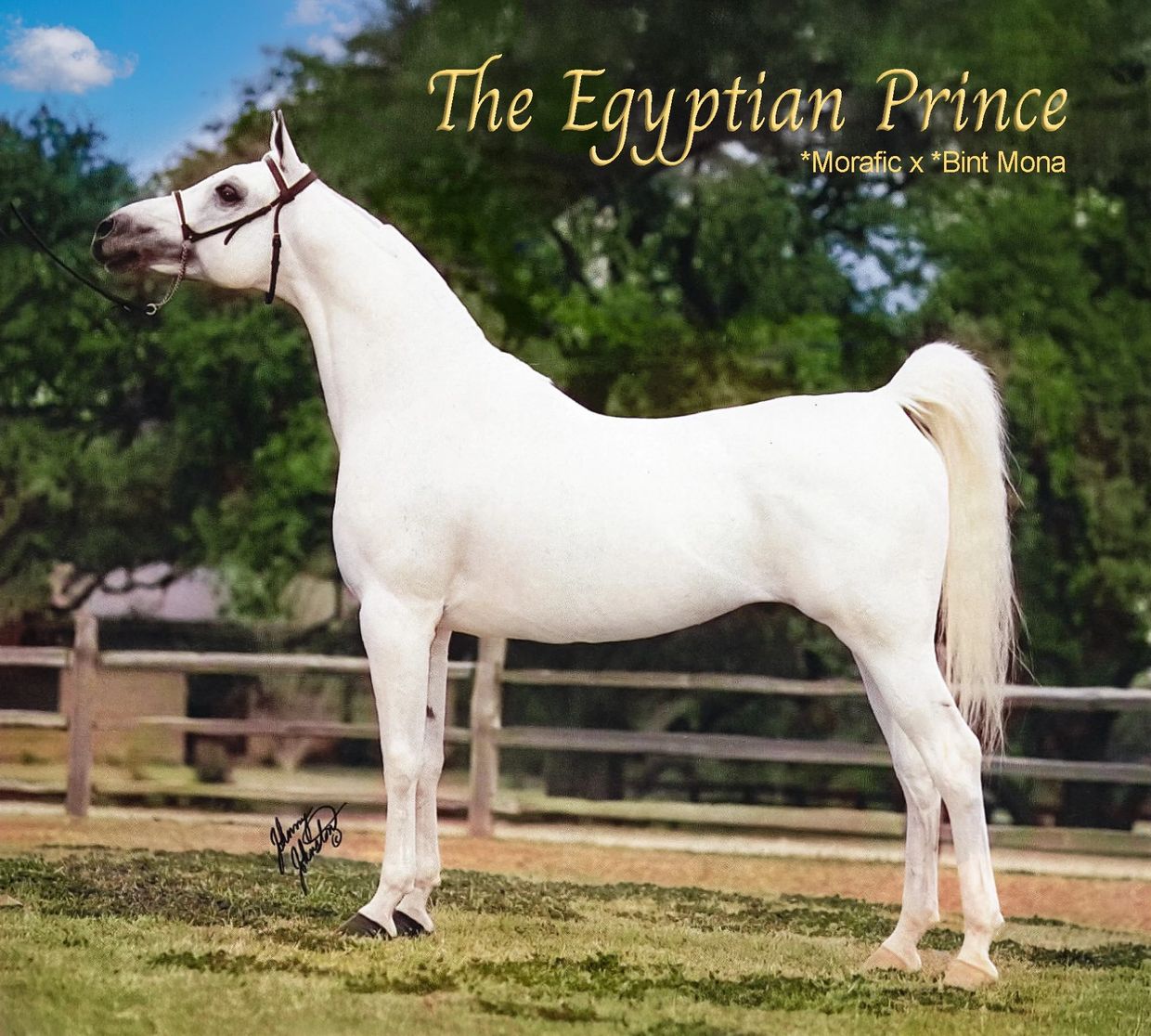
The Egyptian Prince
David Leaser via FB Fans of Gleannloch Arabians 2026
The Egyptian Prince (*Morafic x *Bint Mona by Nazeer) 1967 Gray Stallion
The Egyptian Prince (*Morafic x *Bint Mona by Nazeer) was not just another stallion in the long line of legends. He was a force who reshaped Egyptian breeding across the globe for more than half a century.
His journey carried him from Gleannloch to the Pacific Northwest under the care of Bob Thorndike, to Backacres Arabians with Howard and Sally Stokke and then to Texas where he spent 18 years with Shawn Crews.
To Sally, The Egyptian Prince was not simply “The Prince.” He was her boy. There was a bond between them. Years later, when he stood at Bentwood, he heard Sally’s voice at an event and called to her from his stall. Sally wept, reminded, as we all have been at one time or another, these horses remember us, love us, and carry pieces of our hearts long after they leave our barns.
Though never shown in competition, The Egyptian Prince radiated beauty, presence and kindness, whether under saddle or standing quietly in hand. He embodied the rare blend of strength, refinement and loyalty that breeders spend a lifetime searching for.
His numbers tell a story of influence that few stallions can claim. The Egyptian Prince sired more foals than any son of *Morafic, 826 in total, and his get and grand-get ripple through more than 4,000 pedigrees worldwide. Today, it is estimated that more than 80% of all straight Egyptian Arabians in the United States may carry his blood. From Thee Desperado+ to Ansata Sinan, from Imperial Baarez to Al Ayal AA and countless others, his mark is indelible.
His sons and daughters spread across the globe to Jordan, Brazil, Canada, Belgium, The Netherlands, Saudi Arabia, Argentina, Chile, Qatar, France, Germany, Italy, Israel, Kuwait, Morocco, Great Britain and Australia, making him one of the true international patriarchs of the breed.
To call The Egyptian Prince an “influential sire” understates his place in history. He was the embodiment of the best of *Morafic, a living bridge from the desert heritage of Nazeer to the modern global stage.
The Egyptian Prince left us more than foals, more than pedigrees. He left us with a reminder of what it means to love a horse so deeply that he will call back to you years later, across the distance of time and circumstance.
For those of us privileged to have known or seen him in person, The Egyptian Prince is more than a name in a studbook. He is the voice from the stall, the memory that lingers . . .
Ancestor of:
Ameer El Koloob (US) (Nour Al Kamar MH x DHS Tarah (IRE))
Ibb El Koloob (Ameer El Koloob (US) x Agecroft Layla)
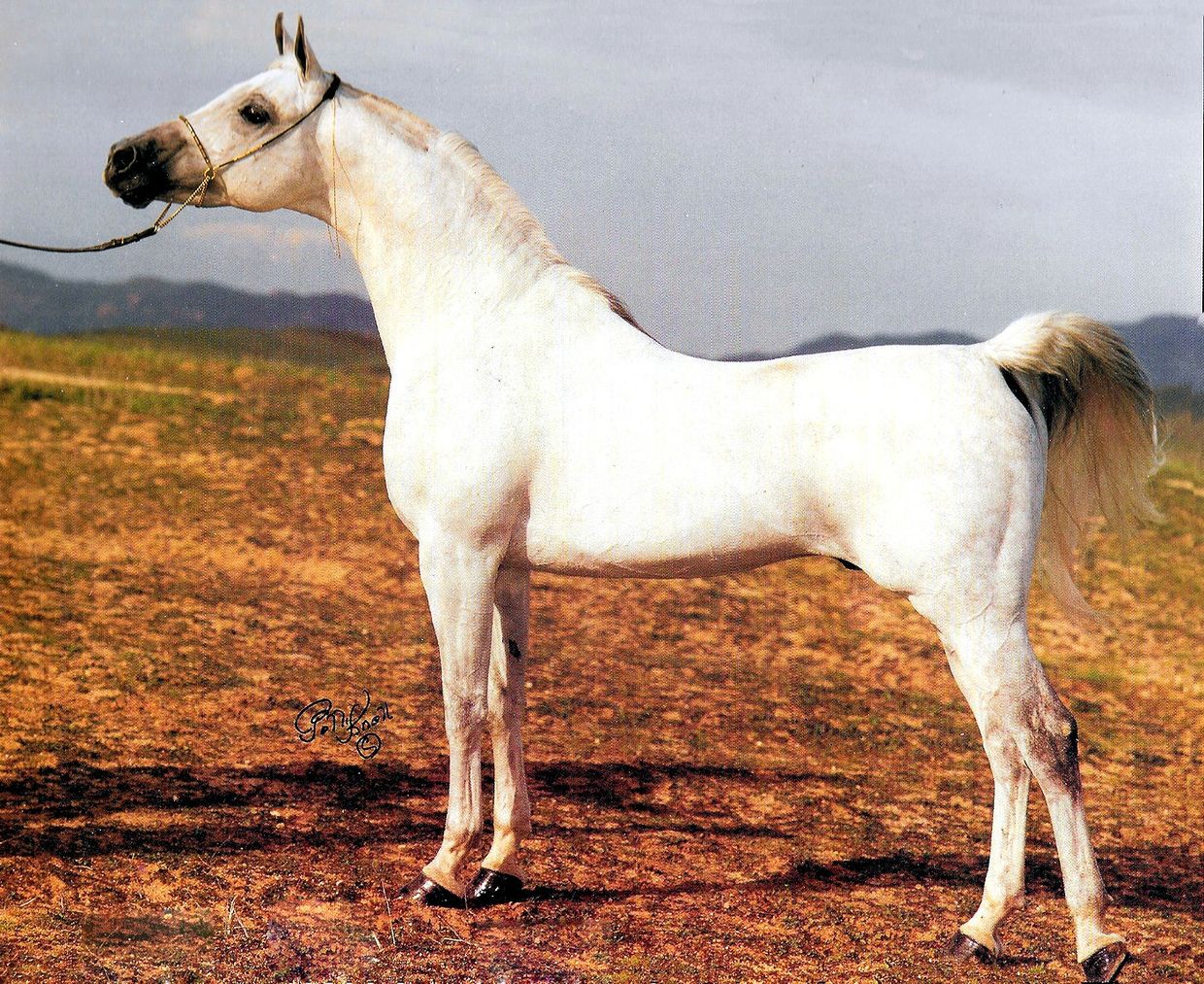
ET Crown Prince
ET Crown Prince Part 1 - Jim Robbins - Fans of Gleannloch Arabians FB 2026
[Jim Robbins'] love conformation shots of horses. They are both a great historical perspective and a great teaching tool for what we’re breeding and what can pop up in a pedigree. Here is the handsome, correct and influential ET Crown Prince (The Egyptian Prince x RDM Maar Hala by El Hilal) in a great shot by the late Polly Knoll standing reasonably relaxed and showing why he was an important sire, grand-sire and so forth around the world. People often today “dismiss” Egyptian stallions when looking for out-crosses, but believe you me, they sire some of the most amazing show and breeding horses when used thoughtfully on Crabbet, Polish, Russian and Spanish bloodlines. Ali Jamaal (Ruminaja Ali x Heritage Memory by El Magato), *El Shaklan (Shaker El Masri x *Estopa by Jacio) and *Gazal Al Shaqab (Anaza El Farid x Kajora by Kaborr+++) are just 3 examples. Now, back to the history of ET Crown Prince.
As are so many great horses & breeders in the PNW and around the country, ET Crown Prince owes his beginnings to Bob and Joanne Thorndike and their Jamal Arabians of Oroville, WA. The Thorndike’s early breeding program was rich in the blood of Sur-Lee (Sureyn x Jubilee by Jubilo), bred by Jim Draper and twice Canadian Top Ten Stallion for the Thorndikes, and their early mare band was headed up by Sura Gem (Sureyn x Gharita by Gharis), also from Jim Draper. From here, Bob became interested in the Egyptian/Crabbet cross and purchased The Egyptian Prince (*Morafic x *Bint Mona by Nazeer), as a youngster and this was quickly followed by the great mare Jubilema (Jubilo x *Menfis by Egypto), with the *Morafic filly and later Canadian Top Ten Mare, Ilaha, at side and bred back to *Morafic for the striking but short lived stallion, The Egyptian Sultan. From here, Bob then went on to Sheila Varian’s, where he found 3-year-old colt that wasn’t working out in her program and bought him to take home. Enter El Hilal (*Ansata Ibn Halima++ x *Bint Nefisaa by Nazeer) who went on to be several times US and Canadian Top Ten Stallion and the leading SE sire for many, many years.
The Egyptian Prince, the sire of ET Crown Prince, was owned by the Thorndike’s for a decade before going into the Banu Al Barr Partnership and then onto Bentwood farms, before his last homes with Marion Gardner (David’s wife) and finally the Sirabasku’s. El Hilal went to a partnership with Ron and Joyce Palelek and Jim and Marilyn Sjolund (the owners of the great *Meczet early on), before becoming synonymous with Ron and Vantage Point Farm. When you study this picture of ET Crown Prince, you see the best of both his sire and grand-sire, along with the substance of the Babson program via his mare-line. Speaking of this, Maar Jumana (Disaan x Maar-Ree by Fasaab), was from Roy and Nellie Jackson’s branch of the Babson program that went to California. Maar Jumana and her dam, Maar-Ree (Fasaab x Maarou by Fay-El-Dine) were both acquired as the foundation mares for Bob and Jeanne Middleton’s farm which evolved over the years into Midcrest Farms and is front and center today through their grandson, Preston Keeter.
With all this background out of the way, ET Crown Prince was bred by Dr. Felino Cruz, Jody Cruz’s dad, out of arguably the best producing SE mare of all time, RDM Maar Hala. She was definitely a great stallion producer, giving us the full brothers El Halimaar and Halim El Mansour (by *Ansata Ibn Halima++, also her grand sire), Prince Ibn Shaikh (by Shaikh Al Badi), one of his best sons, Maar Ibn Amaal (by Amaal), who was purchased by Gleannloch Farms and I believe died young (?) and her last foal, the in-bred Haliluyah MH (by El Halimaar), who always intrigued me as an individual and as a sire.
From great mare-lines come great breeding stallions and the first one to see this in ET Crown Prince was Jean Jennings of Raadin Arabians, who bought ET Crown Prince as a yearling and had him for several years. An astute breeder by anyone’s standards, Jean bred him to her lovely, chestnut *Tuhotmos (El Sareei x Moniet El Nefous by Shahloul) daughter, Om Khamsa (x Raadin Hilal by Sireff) for the horse that would carry on this sire line around the world, Raadin Royal Star, who was exported to Australia as a yearling. A striking grey stallion, he inherited the best qualities from both his parents and as a bonus had the rare Babson *Bint Serra I (Sotamm x Serra by Sahab) mare-line, half-Crabbet Park and half-Egyptian breeding, that went straight back to Bint Helwa. Raadin Royal Star was used by the most prominent breeders of his time, Marian Richmond of Simeon Stud, Tawnya Hawley, David Kemp and Sorella Stud for his 6 foal crops there. The one that put Raadin Royal Star on the world stage as a sire was *Simeon Shai+ (x Simeon Safanad by *Sankt Georg x *27 Ibn Galal-5), who came back to Ron Palelek and Bruce Clark in the US and was the first horse to win it all in one year: Scottsdale, US, Canadian and World Champion Stallion at the Salon in 1991. I remember being at Scottsdale when Shai came into the country and an excited Bruce Clark taking me back to the closed stall to see this stunning bay stallion, who was quietly munching hay and was about as sweet as one would want. From there, *Simeon Shai+ was owned in a partnership, the Shai Alliance, before going to his forever home at Silver Maple Farm and my dear friend Christie Metz who he “owned” for the rest of his life.
ET Crown Prince left lovely mares and great siring sons, with a lifetime total of 108 purebreds and one half-Arabian. My three favorite sons would be Raadin Royal Star (x Om Khamsa by *Tuhotmos), Abraxas-Moonstruck (x SF Moon Maiden by Nabiel+/) and Abraxas Prince (x Cashai by *Simeon Shai+). The list of favorite daughters includes CKM Crown Jewell (x Enshallaa by Prince Fa Moniet), SF Egyptian Dove (x AK Bint Nabilahh by *Ibn Moniet El Nefous), who was exported to Morocco then to Germany, Princess Angelima (x Glorieta Dalima by Ansata Abu Nazeer) and Abraxas-Maar-Hala (x Bint Maar Hala by Shaikh Al Badi), who was a double granddaughter of RDM Mar Hala. And, then there’s the grandson, *Simeon Shai+, who left 472 purebreds, most in the US and 22 in Australia. He has bred on world-wide and guaranteed ET Crown Prince a place in the important sire-line category for all time.
When he was middle aged, ET Crown Prince was acquired by Debra and Emil Nowak for their Abraxas Arabians, and they owned him for the rest of his life. Debra in particular, was a breeder’s breeder. She studied pedigrees and conformation like a woman on a mission, and some of the loveliest ET Crown Prince foals were born at Abraxas. ET Crown Prince lived his best life at their farm and was given every opportunity, both as a sire and as a friend, to enjoy life as all older stallions should. I’ll post relaxed conformation photos of The Egyptian Prince, El Hilal and *Simeon Shai+ to show the quality and consistency of this great sire-line so look for them as they are all pieces of the breeding puzzle.
Ancestor of:
Ameer El Koloob (US) (Nour Al Kamar MH x DHS Tarah (IRE))
Ibb El Koloob (Ameer El Koloob (US) x Agecroft Layla)

The Egyptian Prince with Sally Stokke at Backacares
Jim Robbins continues Part 2 - Fans of Gleannloch Arabians 2026
This wound up being a multi-part post, since I was able to find reasonably relaxed photos of both the sire and grand sire of ET Crown Prince (The Egyptian Prince x RDM Maar Hala by El Hilal). Here is his sire, The Egyptian Prince (*Morafic x *Bint Mona by Nazeer) with Sally Stokke in a rarely seen photo from Backacares when he stood there. This second one is hopefully a teachable moment, showing the consistency, quality, smoothness and elegance of these horses. Here’s his sire, The Egyptian Prince (*Morafic x *Bint Mona by Nazeer), bred by Gleannloch and shown here in my favorite Sparagowski photo of him. One top of being *Morafic’s most prolific son, with 826 foals and his grand-get number at least 4335., The Egyptian Prince is found in probably more new SE pedigrees then any contemporary SE Stallion today.
The Prince also ties in the Thorndikes, who owned both him and El Hilal (*Ansata Ibn Halima++ x *Bint Nefisaa by Nazeer) for a period of time and the breeders of both of these important sires, Doug and Margaret Marshall of Gleannloch Farm. Since I’ve done at least two lengthy write ups on The Egyptian Prince over the years, I’ll keep this brief. Look at the photo of ET Crown Prince and compare it to the photo of his sire. The Egyptian Prince brought forward all of his best qualities without overshadowing his great dam-line. Next, El Hilal.
Ancestor of:
Ameer El Koloob (US) (Nour Al Kamar MH x DHS Tarah (IRE))
Ibb El Koloob (Ameer El Koloob (US) x Agecroft Layla)
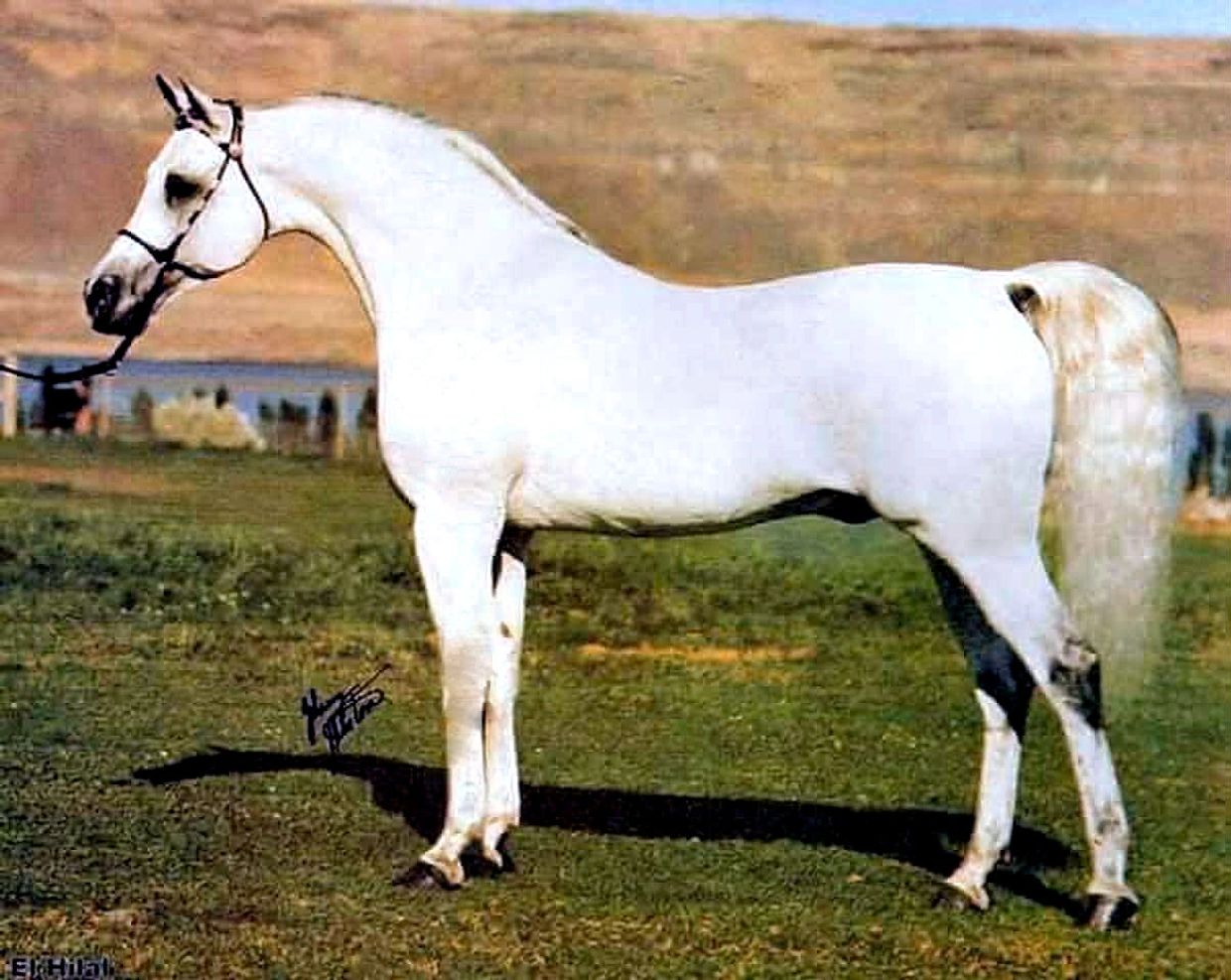
El Hilal
Part 3 by Jim Robbins - Fans of Gleannloch Arabians FB 2026
El Hilal
The third piece of the ET Crown Prince pedigree is the great El Hilal (*Ansata Ibn Halima++ x *Bint Nefisaa by Nazeer), in a relaxed stand-up photo by the master, Johnny Johnston, taken at Vantage Point Farm. El Hilal also ties together Bob and Joanne Thorndike, early Washington breeders, as they owned both El Hilal and The Egyptian Prince (*Morafic x *Bint Mona by Nazeer) at various times. It also ties in the Marshall’s of Gleannloch Farm, who bred both of these great stallions. I’ve already written extensively about El Hilal, including vintage amateur photos of him, so just do a Facebook search and it will bring up the article.
With over 50 National Champions, most in halter a few in performance, and over 60 Top Tens, a few more in performance then halter, El Hilal was everything a show horse and sire should be. For many, many years he was the leading living SE sire of champions and, to be honest, I’m not sure if that record still stands or not. Ha! Either way, he was an important piece of the pedigree puzzle for ET Crown Prince, who was out of his most prolific SE daughter, RDM Maar Hala (x Maar Jumana by Disaan), which brings in two more great breeders, the Middleton's of RDM fame and Roy and Nellie Jackson, who based their program on straight Babson breeding throughout the years.
Ancestor of
Ameer El Koloob (US) (Nour Al Kamar MH x DHS Tarah (IRE))
Ibb El Koloob (Ameer El Koloob (US) x Agecroft Layla)

Ibn Hafiza
David Leaser - Fans of Gleannloch Arabians FB 2026
*Ibn Hafiza (Sameh x Hafiza) 1959 Bay Stallion
*Ibn Hafiza’s story begins with Egyptian royalty.
In 1952, after King Farouk of Egypt was deposed in a revolution, the King’s Inshass stable of horses, including Sameh, were disbursed, auctioned or transferred to the Egyptian Agricultural Organization (the post-revolution name for the Royal Agricultural Society).
Sameh contributed well at the E.A.O., passing on extreme trotting action and smooth conformation. His most outstanding son was *Ibn Hafiza, foaled in 1959, out of Hafiza, a mare sired by Hamdan (another Inshass stallion) out of a Hamdan daughter, Matouza.
In 1970, Douglas and Margaret Marshall brought *Ibn Hafiza to Gleannloch to cross on *Morafic daughters. At Gleannloch, he sired 38 foals, before being sold to Bentwood Farms in 1977.
*Ibn Hafiza ultimately sired 76 foals in the United States, the last in 1984. He left a significant legacy through his offspring at Gleannloch. Some of his most winning offspring include:
Almileegy++ (x *Bint Bint El Samraa)
- 1976 US National TT English Pleasure
- 1976 US National Reserve Champion Western Pleasure
- 1977 US National TT Western Pleasure
- 1978 US National TT Western Pleasure
- 1978 Canadian National Champion Western Pleasure
Gamal Al Arab+++ (x *Gamilaa)
- 1978 Canadian National TT Native Costume
- 1978 US National TT Futurity Stallion
- 1979 US National Reserve Champion Native Costume
- 1980 US National TT Native Costume
- 1982 US National TT Native Costume
El Dayim++ (x *Nahlah++)
- 1979 Canadian National TT Western Pleasure Horse
- 1975 US Nationals TT Futurity Stallion
Shamruk++ (x *Bint Maisa El Saghira++)
- 1979 Region 17 Reserve Champion English Pleasure
- 1982 Scottsdale TT Native Costume
Almawardy+ (x Dahmah Shahwaniah)
- 1978 Region 16 Reserve Champion Halter Stallion
- 1981 Region 16 Top Five Halter Stallion
- 1981 Region 15 Top Five Halter Stallion
- 1982 East Coast Top Five Stallion
Joe Ferriss, in his article "What did not get away Part 1 Musing on what still can be." [Arabian Essence TV Newsletter] writes:
"Ibn Hafiza (Sameh x Hafiza) was an incredible mover. He was much more handsome in person than in pictures. He walked like a panther covering lots of ground and had the most beautiful silhouette.
Ancestor of:
Khe Amin Tabou SSR (US) (Al Reyhan Marou x Anisa Gamal)
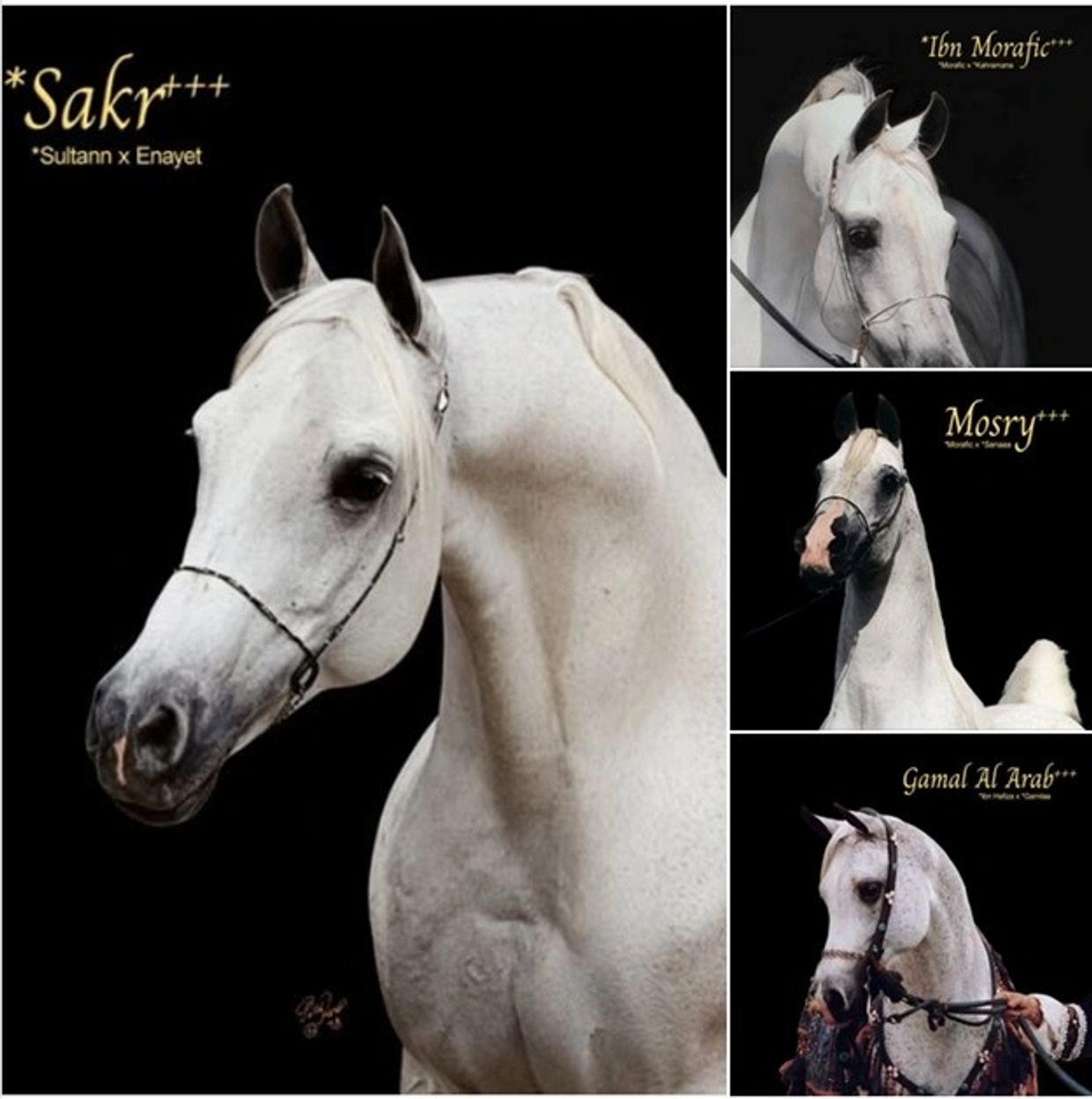
The Egyptian Fab Four
David Leaser - Fans of Gleannloch Arabians FB 2026
The Egyptian Fab Four:
*Sakr+++
Ibn Morafic+++
Mosry+++
Gamal Al Arab+++
Four stallions. One legacy. The Egyptian Fab Four are the only Straight Egyptian Arabian stallions in history to earn the Legion of Supreme Merit, and every one of them traces back to Gleannloch Farms:
• All were either born or shown by Gleannloch.
• All were either sons or grandsons of the legendary *Morafic.
Their stories form a living bridge between the golden era of Egyptian Arabians and the influence we still feel in today’s breeding programs.
*Sakr+++ (*Sultann x Enayat by *Morafic)
When *Sakr+++ arrived at Gleannloch as a young *Morafic grandson, no one could have predicted the whirlwind he would become. Under Tom McNair’s expert training, he exploded into the national spotlight, dominating halter, park, and native costume for nearly a decade. Crowds roared, “Sic ‘em *Sakr!” every time he entered the arena, and his drive, charisma, and heart made him one of the most beloved Egyptian stallions of all time. His 15 national titles, versatility, and sheer joy for performing cemented his place as one of the greatest ambassadors the breed has ever known.
Ibn Morafic+++ (*Morafic x *Kahramana)
Carrying the name of *Morafic is a heavy crown, yet Ibn Morafic+++ wore it with unmistakable authority. Born at Gleannloch as Abu Khail, he was renamed after his sire’s sudden death, instantly becoming the colt chosen to carry forward a dynasty. His first trip to the U.S. Nationals ended in triumph as the 1976 U.S. National Champion Futurity Stallion, proving he was more than a reflection of his sire — he was a force of his own. Later honored as an Arabian Horse World “Sire of Significance,” Ibn Morafic+++ became one of the rare Straight Egyptian stallions to earn the Legion of Supreme Merit.
Mosry+++ (*Morafic x *Sanaaa)
Born from the powerful cross of *Morafic and *Sanaaa, Mosry+++ represented the very best of Gleannloch’s program. Acquired as a weanling by Lu and Burr Betts, he flourished under the masterful hands of trainer Carol Chapman, becoming a standout in halter, English pleasure, and western pleasure. His wins and versatility earned him the Legion of Supreme Merit and positioned him among *Morafic’s most accomplished sons. As a sire, Mosry+++ carried his influence forward through more than 100 offspring and left an enduring mark.
Gamal Al Arab+++ (*Ibn Hafiza x *Gamilaa by *Morafic)
Gamal Al Arab+++ was the embodiment of Gleannloch’s vision: The cross of *Ibn Hafiza on a *Morafic daughter. Early observers recognized his exceptional conformation and athleticism, and he quickly rose through the ranks to become a five-time national winner in halter and performance — even while battling a serious internal illness that was only later discovered and corrected. Sadly, he sired just 26 foals, but his quality left a strong imprint, proving that true greatness is measured not only by numbers but by impact.
Ancestors of
Ameer El Koloob (US) (Nour Al Kamar MH x DHS Tarah (IRE))
Ibb El Koloob (Ameer El Koloob (US) x Agecroft Layla)
Khe Amin Tabou SSR (US) (Al Reyhan Marou x Anisa Gamal)
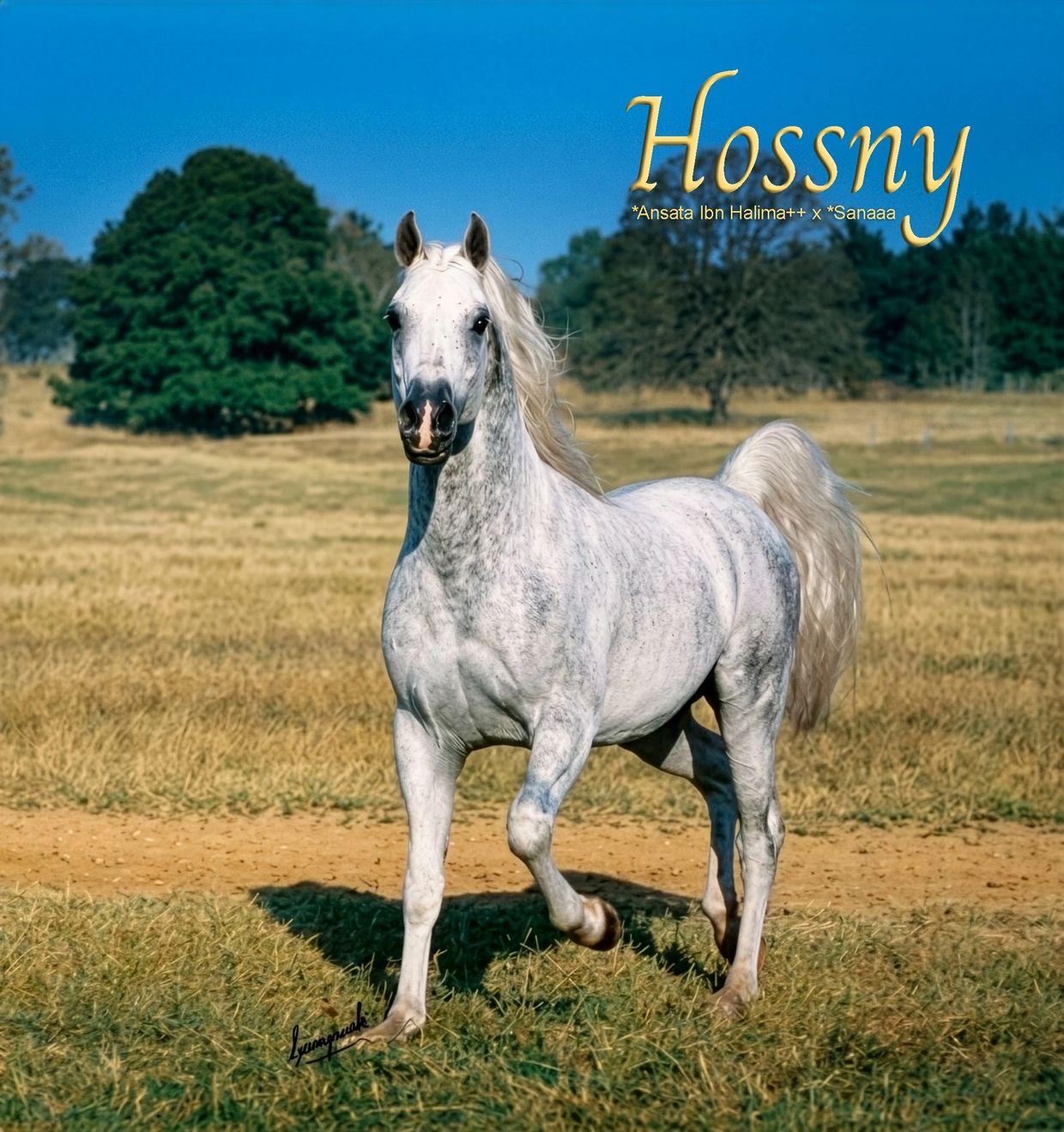
Hossny
David Leaser - Fans of Gleannloch Arabians FB 2026
In 1965, Gleannloch leased *Ansata Ibn Halima++ from Ansata. Under Tom and Rhita McNair, he was not just shown, he was established, proving himself in halter, park, and English pleasure. It was a pivotal moment in time for the new Egyptian imports, and *Ansata Ibn Halima++ played a essential role in establishing their popularity in America.
But it was the foal crop that year which ultimately became something far more enduring. From that breeding season came what Jim Robbins would later call “The Class of ‘66,” a group of Egyptian Arabians who would influence generations:
• El Hilal, grey stallion (x *Bint Nefisaa by Nazeer)
• Hossny, grey stallion (x *Sanaa by Sid Abouhom)
• Mohssen, grey stallion (x *Bint Mona by Nazeer)
• Samim, grey stallion (x *Solomy by El Sareei)
• El Hadiyi, bay stallion (x *Sammara by *Morafic)
• Dahmah Shahwaniah, bay mare (x *Bint Maisa El Saghira++ by Nazeer)
Among them, Hossny stood as both continuation and beginning. His dam, the Sid Abouhom daughter *Sanaaa, produced Hossny as her first foal. That first foal would set the tone for everything that followed. Later, *Sanaaa would produce additional siblings by *Morafic, including Al Fahir, Fardos, and Mosry+++, each helping to cement the value of Egyptian breeding with their U.S. National Top Ten wins.
As a young colt, Hossny drew the attention of the Kurth family, who purchased him for their Alameda Arabian Farm. It was there that Hossny stepped from promise into production and performance, earning (like his father) championships in halter, park and English pleasure, a rare versatility even in that era.
More importantly, he began to extend himself forward. At Alameda, Hossny sired Bairaq++, a Legion of Merit winner and 1975 U.S. National Top Ten English Pleasure AOTR horse, along with Al Hussar, a U.S. National Top Ten Native Costume competitor. IHossny was proving he could sire Arabians with exceptional performance across disciplines.
In the 1970s, Hossny was first leased and then purchased by Imperial Egyptian Stud in Maryland for their emerging Egyptian breeding program. There, surrounded by an outstanding herd of mares, his breeding role deepened.
Hossny became one of only five stallions bred to U.S. National Champion Mare *Serenity Sonbolah, a pairing that marked him as part of a very small, very deliberate circle of influence. From that cross came a son, Imperial Biarritz, and Imperial Sonbesjul, a daughter who would extend Hossny’s footprint into the next generation, especially through her son, U.S. Top Ten Futurity Stallion Imperial Al Kamar, sired by El Hilal (*Ansata Ibn Halima x *Bint Nefisaa), another member of the Class of ‘66.
By the end of his American career, Hossny had sired 85 foals in the United States. In 1981, Count Zichy-Thyssen acquired him and he was exported to South America, where he added another 15 offspring to his legacy.
What remains is not simply a record of production, but the legacy of a stallion whose influence moved through breeders, programs and continents.
Hossny did not just participate in “The Class of ‘66.” He helped define what it meant for that class to endure.
Ancestor of
Ameer El Koloob (US) (Nour Al Kamar MH x DHS Tarah (IRE))
Ibb El Koloob (Ameer El Koloob (US) x Agecroft Layla)

Gamal Al Arab
David Leaser - Fans of Gleannloch Arabians FB 2026
Gamal Al Arab+++ (*Ibn Hafiza x *Gamilaa by *Morafic) 1975 Stallion
The first time I saw Gamal Al Arab+++ was at one of the first Egyptian Events. In those early days,
all of the legends were there, from The Egyptian Prince to *Farazdac and *Tuhotmos.
I had the wonderful pleasure of spending time at that Event with Marion Richmond, Tanya Hawley and Rik Augustine, three amazing people with incredibly good taste in beauty and quality. Together, we walked through the barns and examined the stallions carefully, going into the stalls with many of them. So many outstanding horses, but once I put my “judges cap” on, examining legs, shoulders, etc., one stood out for his excellent conformation: Gamal Al Arab+++.
Gamal Al Arab+++ represents the best of what Gleannloch sought to produce by crossing *Ibn Hafiza on *Morafic daughters, like *Gamilaa. Born at Gleannloch in 1975, Gamal Al Arab+++ showed promise at an early age, winning his first national titles at age three as a US Top Ten Futurity Stallion and Canadian National TT Native Costume.
Gamal Al Arab+++ showed his versatility as he racked up impressive wins:
1978 Canadian National TT Native Costume
1978 US National TT Futurity Stallion
1979 US National Reserve Champion Native Costume
1980 US National TT Native Costume
1982 US National TT Native Costume
1990 Egyptian Event Champion Show Hack
1990 Egyptian Event TT Native Costume Open
And he achieved many of these accomplishments with a hidden illness: Maggie McNair Huggins said they had to remove a large section of his intestines, after which, his energy soared.
Sadly, he only sired 26 foals, but Gamal Al Arab+++ was able to breed some of Gleannloch’s finest mares and leave behind outstanding individuals, like Kalil Al Arab, (Gamal Al Arab++ x To-Phet by *Talal), 1989 Egyptian Event TT World Champion Stallion.
Ancestor of:
Khe Amin Tabou SSR (US) (Al Reyhan Marou x Anisa Gamal)
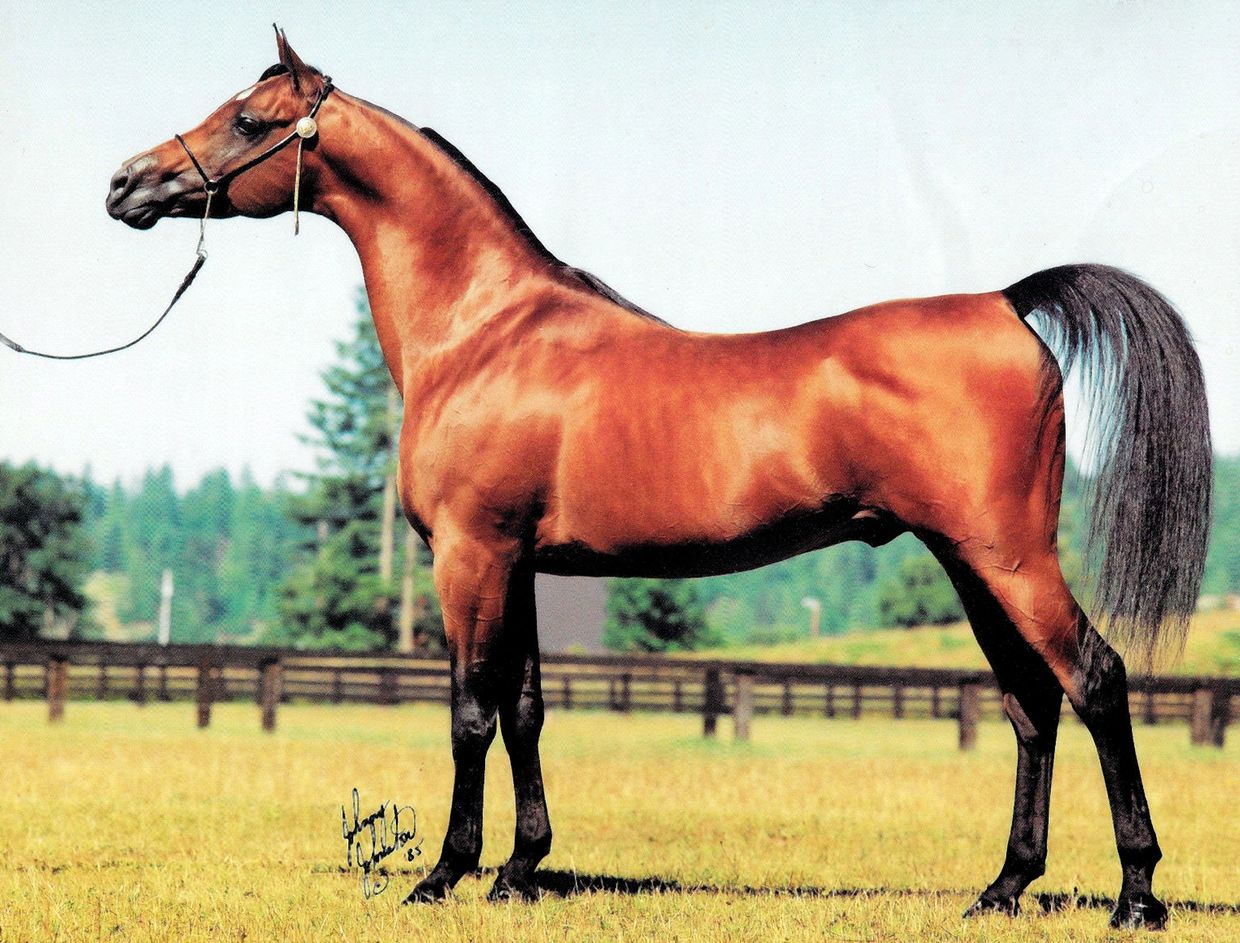
Abenhetep
Jim Robbins - Fans of Gleannloch Arabians FB 2026
My favorite photo, from the file cabinet, of the much-loved sire Abenhetep (*Ibn Hafiza x *Omnia by Alaa El Din) from the master himself, Johnny Johnston. About as correct, elegant and 3-circle as one could want, Abenhetep was bred by the Marshall’s at Gleannloch Farm and purchased by Howard and Sally Stokke as a 4 year old in 1980. He was sired by Gleannloch’s Nazeer/*Morafic out-cross sire, *Ibn Hafiza (Sameh x Hafiza by Hamdan), who worked well on the *Morafic daughters, and out of *Omnia (Alaa El Din x Ameena by Hamdan), who was roughly 45%+ Crabbet Park breeding. This was a particularly good mare-line for the Marshalls, as *Omnia produced 1 great daughter, Bint Omnia, and 3 good sons: Zedann, Maalik and Mageed by the great *Morafic. From there, *Omnia was bred to *Ibn Hafiza twice, for Abenhetep and legendary Kisra, who went on to found a dynasty for Dorian and Andrew Weil in NY state. AK Khattaara (by *Ibn Moniet El Nefous), was *Omnias last daughter and she left a dozen foals in the US before being exported to Italy.
Abenhetep was the 2nd great straight Egyptian stallion for the Stokke’s, the first being their Banu Al Barr partnership on The Egyptian Prince (*Morafic x *Bint Mona by Nazeer), who stood at stud with the Stokke’s during the 70’s until his sale to Bentwood Farms. As a show horse, “Tep” did well at halter but as a sire he really came into his own. Had he only sired Patrick and Lisa Swayze’s great Tammen (x Talgana by *Talal), he would go down in history. With 198 foals, all purebred, Abenhetep will be remembered as the sire of beautiful mares, great show and pleasure geldings and the occasional colt that carry on his name today. Over the years, the top breeders in the PNW and around the country used Abenhetep as a cross on their mares. This list included everyone from Bob and Jeanne Middleton, Sandra Viert, John & Joyce Hurd and Gerry Canda to Tom and Rhita McNair and the Marshalls. The best crosses with Abenhetep were daughters of El Hilal and The Egyptian Prince, but he also did very well on *Raffles and CMK mares that abounded in the Pacific Northwest.
I was fortunate enough to get all of Sally Stokke’s Arabian horse memorabilia when she left her farm and have scrapbooks full of photos and information on their horses from the beginnings with the *Raffles bred R-Dukhan (Tut Ankh Amen x Bint Ardith by Kubriya), through their The Egyptian Prince Years to their last chapter with Abenhetep. Always a delightful couple to visit, having spent a few nights with them over the years, the Stokke’s and their beautiful horses, especially Abenhetep, will always hold a special place in my heart and the hearts of so many they touched.
Ancestor of:
Ameer El Koloob (US) (Nour Al Kamar MH x DHS Tarah (IRE))
Ibb El Koloob (Ameer El Koloob (US) x Agecroft Layla)

Sakr
Jim Robbins & David Leaser - Fans of Gleannloch Arabians FB 2026
Somebody on here had asked about *Sakr+++ and his stunning native costume, so here he is. Sic 'em *Sakr+++!
A chant heard in show rings around the US for a decade, when Tom McNair entered the arena on the spectacular and charismatic *Sakr+++ (*Sultan x Enayat by *Morafic). Imported, along with the famous Egyptian mares *Deena, *Habeeba, *Gamilaa and *Bint Hanaa, by the Southern Texas businessman H. J. Huebner as a coming yearling, *Sakr+++ and the 4 mares he arrived with were all acquired by the Marshall's of lGleannloch Farm in November of 1969. A tall, gangly yearling at the time, *Sakr+++ blossomed under the attention of the McNair's and the following October made his show ring debut at halter at the huge Texas State Fair, winning Champion Stallion and Most Classic with Tom McNair handling. And so the legend began............
Over the next decade, Tom and *Sakr+++ amassed well over a hundred championships in Halter, Most Classic, Park Horse and Native Costume. Many of them at the Regional and National Level. If there was a major Arabian show or event, such as the Arabian Horse Fairs, *Sakr+++ and Tom were there, usually winning championship after championship. In Park Horse classes, *Sakr+++ bested the best of Lasma's *Bask++ sons, as they frequently dueled it out for the championship trophy. In Native Costume, *Sakr again excelled (many times going a little too fast at the hand gallop) to the thunderous applause of the crowd in a stunning Syrian costume that the Marshall's had custom made for him. With an incredibly heavy show schedule for a decade, *Sakr+++ still managed to leave his mark in the breeding shed, siring a lifetime total of 105 get and he bred on through 1,618 grand-get in the US and through his exported offspring that went to Brazil, Argentina, Sweden and Denmark. His first foal, and by far his best known, and most prolific son, was the extraordinary show horse and sire, Nabiel (x *Magidaa by Alaa El Dine). Nabiel was purchased by longtime friends and clients of Gleannloch, Mr. and Mrs. Bill Trapp, as a yearling. He was 1974 US National Champion Futurity Colt and twice US Top Ten Stallion in huge classes, in addition to founding a dynasty of some of the most glorious broodmares in the breed.
Now, back to *Sakr+++. At the Gleannloch dispersal sale in 1992, the Marshall's gifted *Sakr+++ to his long time best friends, Tom and Rhita McNair, and he lived out his life at Thistlewood Farms in Texas, where he passed away in 1997 leaving an indelible mark on both the show ring and the breeding shed that is still felt today. Here's to *Sakr+++, the ultimate, electrifying show horse that set a standard that has still not been bested today!
David Leaser:
*Sakr+++
(*Sultann x Enayat)
1968 Grey Stallion
In 1968, Doug and Margaret Marshall decided to go all in on the Straight Egyptian breeding program at Gleannloch. That same year, HJ Huebner imported a group of horses from Egypt, including a weanling colt named *Sakr+++ (*Sultann x Enayet). The Marshalls were taken by the young *Morafic grandson and purchased him in 1969, along with a number of fine mares (*Habeeba, *Gamilaa, *Deenaa and *Bint Hanaa) who helped form a foundation for their new program.
No one could've imagined that this colt would end up becoming one of the most important ambassadors for Egyptian Arabians in America — and also become a household name in the Arabian horse industry. But under the expert tutelage of the amazing Tom McNair, that's just what happened.
Almost immediately, *Sakr+++ began winning in the show ring, first in halter and then in performance. By age three, *Sakr+++ was winning in Park. And he quickly became a crowd favorite. Audiences screamed, “Sic ‘em, *Sakr+++!” whenever he entered the showring.
Tom McNair once said, "*Sakr+++ was physically able to do anything he wanted to do and mentally capable of accomplishing it without getting rattled. He's one of the few horses I know of that was shown for ten years and still loved every minute of it. If they made the class long enough, there was no way anyone was going to beat him because he just got better. He had a heart as big as he was and if you kept asking him I honestly think he would drop dead before he'd quit trying.”
*Sakr+++’s partial record:
1971 US National TT Park
1972 US National TT Park
1972 US National TT Stallion
1973 US National Reserve Champion Park
1974 US National Reserve Champion Park
1976 US National Champion Native Costume
1976 US National TT Park
1977 US National Champion Native Costume
1977 US National Reserve Champion Park
1978 US National Champion Native Costume
1978 US National TT Park
1978 Canadian National TT Native Costume
1978 Canadian National Champion Park
1979 US National Champion Native Costume
1979 US National TT Park
When Gleannloch closed its doors, the Marshalls presented *Sakr+++ to Tom and Rhita McNair, ensuring he would be in the best, most loving hands for the rest of his life.
*Sakr+++ proved to be a great sire of champions, including four National winners:
Nabiel+/ (*Sakr+++ x *Magidaa)
US National Futurity Champion Halter Stallion
US National Top 10 Stallion (twice)
Sugaa++/ (*Sakr+++ x *Magidaa)
Canadian National Top Ten English Pleasure (twice)
Canadian National Top Ten Pleasure Driving
Shakr+/ (*Sakr+++ x Zeonah)
US National Champion Native Costume
US National Top Ten Native Costume (twice)
Ala Ibn Sakr+ (*Sakr+++ x Bint Jubilema)
US National Top Ten Native Costume
*Sakr+++ passed away in May 1997 at the ripe old age of 29. He left a lasting legacy for Gleannloch through his 105 offspring.
https://www.youtube.com/watch?v=PXo8IFlFM0I
==//==
Ancestor of:
Khe Amin Tabou SSR (US) (Al Reyhan Marou x Anisa Gamal)

Soufian
David Leaser - Fans of Gleannloch Arabians FB 2026
*Soufian (Alaa El Din x Moniet El Nefous) 1968 Stallion
I first saw *Soufian when he was on lease from Gleannloch to Windfall in Pennsylvania. The Sheas wanted to cross *Soufian on their primarily domestic/Polish mares with Radamason++, *Naborr and *Witez II breeding. *Soufian proved to be an asset, siring very high-quality daughters with their mares, including a near-perfect gray filly named SS Soufianna, out of the *Naborr daughter, Annaborr.
*Soufian was one of the last foals of Moniet El Nefous, arguably the most influential mare in the EAO’s history. Her daughter, Mabrouka, of couse, was the dam of the legendary *Morafic. Moniet El Nefous also counted as offspring *Ibn Moniet El Nefous, *Tuhotmos, Mouna, *Fakher El Din, *Bint Moniet El Nefous and Lubna. *Soufian, and then Ameer, would be her last two offspring.
*Soufian was imported as a weanling in 1968, not even a year old. He would go on to leave a lasting mark on the Arabian world, siring 52 offspring, including US National Top Ten Futurity Stallion Rofann (x Bint Romanaa++ by *Morafic).
And the perfect gray filly from Windfall? Soufianna would help *Soufian place his name into thousands of pedigrees when she became the grandmother of U.S. and Canadian National Champion Stallion, Echo Magnifficoo.
Ancestor of:
Khe Amin Tabou SSR (US) (Al Reyhan Marou x Anisa Gamal)
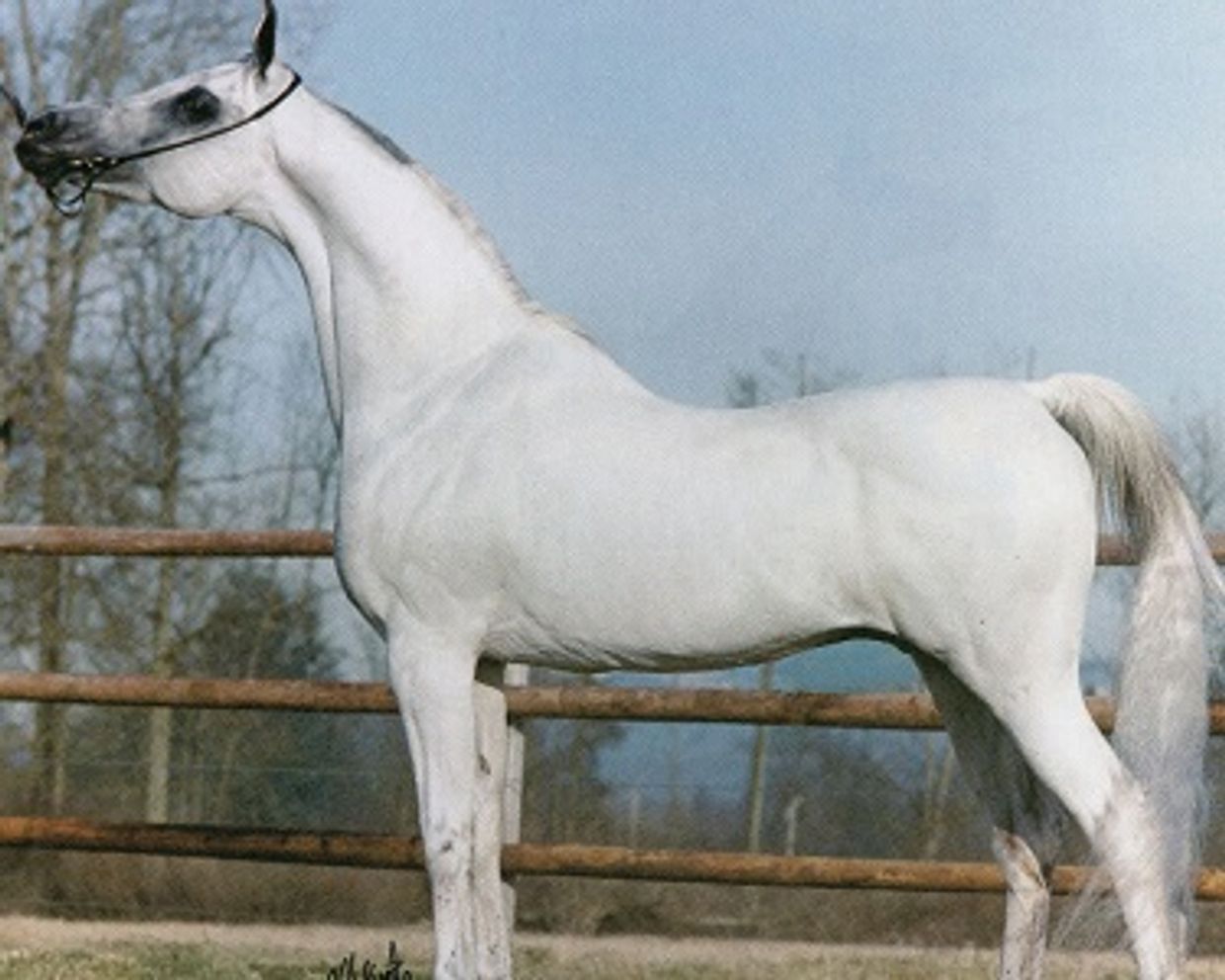
Farazdac
The Greats of The Past: Farazdac & Iknatoon AHW 2/2023 - Domernico Tocchi; Translation Sonia Smaldon
The story about the purchase of the Haban Enzahi stallion Farazdac (23/2/1966 -28/2/2001) (Alaa El Din x Farasha) began when in 1974 he was imported to America.
Wegdan (Dani) El Barbary, owner of Shams El Asil Stud farm, sponsored Farazdac’s race training for a number of years. Farazdac won his first three races, including one victory where he beat a top racehorse. This fact was evoked by Danni el Barbary who said, “He was not good enough to win, he was not ready for the race either, but he ran with all his heart and won!”. While racing, Farazdac didn’t sire many foals, as he was kept at a stallion depot before his return to El Zahraa.
The Lowes and the Hebers strongly believed in combing Farazdac bloodlines with those of Tuhotmos.
Farazdac’s pedigree displays names that delight any SE breeder: Nazeer, Sid Abouhom, Shahloul, Mansour, Sheikh El Arab, El Deree, along with Gamil Manial, Mabrouk Manial, Ibn Rabdan and Rabdan El Azrak.
Farasha (x Yosreia) is also the dam of Felah and Galal. Farasha became famous for producing top-quality mares and stallions of the calibre of Raffat (Aswan).
1978 Farazdac became the sole property of Lowe Arabians. The Lowes leased a ranch near Canon City, Colorado. It was set at a high altitude that suited Farazdac better. He was calmer and more relaxed, retaining his ideal weight during the breeding season.
An important daughter of Farazdac is Fasarra (out of Masarra (Tuhotmos x Bint El Nil x Anter), a great granddaughter of Yosreia. Fasarra was bred in EAO and imported to the USA by the Hebers of Ranchara Arabians in 1973. Fasarra was the dam of Richter MH by El Hlimaar (Ansata Ibn halima x RDM Maar Hala).
Ancestor of:
Agecroft Layla (Talika Farad x Talika Sirina bint Sirdahn)
Agecroft Ghayl (Greenmantle Ghashahn x Talika Sirina bint Sirdahn)
Ameer El Koloob (US) (Nour Al Kamar MH x DHS Tarah (IRE))
Ibb El Koloob (Ameer El Koloob (US) x Agecroft Layla)

Ikhnatoon
The Greats of The Past: Farazdac & Iknatoon AHW 2/2023 - Domernico Tocchi; Translation Sonia Smaldon
With Farazdac’s unexpected sale in 1974 to the USA, the need for the EAO to find an “heir” became a significant issue. The choice fell on an attractive colt born after Farazdac had left for north America, the grey Ikhnatoon (Farazdac x Bint Om El Saad) was chosen.
Ikhnatoon grew into a majestic stallion and would prove to be one of the most positively impacted stallions in the EAO breeding programme by the end of his career.
Ikhnatoon had a remarkable impact at El Zahraa through the beautiful daughters he sired. He was not an easy stallion to breed and the most suitable mares had to be carefully selected. An analysis of his produce, it can be said that Ikhnatoon produced best with mares that did not have Nazeer in their pedigree, such as the grey Kot El Koloob (1985) from Ghadeer x Anter or the bay Ifrag from Amoura x Nasralla. Other outstanding progeny includes Tee (1995) (Adl x Bint Ibtasam) who produced the compelling EAO stallion, Tagweed (2004) by Gad Allah (Adeeb x Ominia).
A heavily built stallion, Ikhnatoon closely resembled the phenotype of powerful horses such as El Deree and his son Sid Abouhom, both pedigreed through his dam Farasha. Ikhnatoon was a stallion of incredible temperament personality and presence, conveying great power and strength. His build had large side diameters, both front and rear. Compared to the standard of his grandsire, the highly refined Alaa El Din, Ikhnatoon appeared slightly heavy in bone structure. However, he had a nice well-set neck with a good mitbah, good length and in harmony with the rest of the body. He was a stallion with good depth of shoulders and high withers. His top line was sightly long and supple, his loins moderately strong. Ikhnatoon had a solid croup with an excellent tail set-up. His powerful movement covered a lot of ground and had a suspension in the air, which made it appear as he were floating above the ground. It was ‘poetry in motion’. He had a very refined head, not very short, and a fine, elegant muzzle, although his eyes were a little high. The eyes were perhaps his only fault. There was sometimes something lacking in his progeny as well, in terms of eye positioning and size.
Nevertheless, despite these unwanted little faults, Ikhnatoon had the great credit of generating many positive characteristics, including siring grey foals with no white marks and with four strong black hooves. I think Ikhnatoon’s geat personality was why he endeared himself to so many people. Not only was he unforgettable, but he embodied all that was good about Egypt, inspiring Egyptians to celebrate their culture, heritage and history with the same pride. Ikhnatoon displayed. I will close this chapter with a quote from Dr Ibrahim Zaghloul, former Director General of EAO, “And for me, there is always Ikhnatoon. He had a presence and character like no other stallion I have known. The day of that first show in El Zahraa, when I had to announce that he had passed away, that morning was something that does not leave me even now.”
In the summer of 2017, Dr Chess Hodson published his complex DNA study to determine the reliability of the dam lines in the EAO breeding program. The results showed that Venus, Rodania DB (1869), Hind (1942) and Bint Karima (1935) shared the same Haplotype, pointing to a single common ancestress in these four foundation families. Considering this information, Ikhnatoon has the same female progenitor four times, strengthening this bloodline even further. Two bloodlines are found in the female branch and two in the male branch. This genetic peculiarity has indeed contributed to making Ikhnatoon an exceptional sire.
Ancestor of:
Ameer El Koloob (US) (Nour Al Kamar MH x DHS Tarah (IRE))
Ibb El Koloob (Ameer El Koloob (US) x Agecroft Layla)
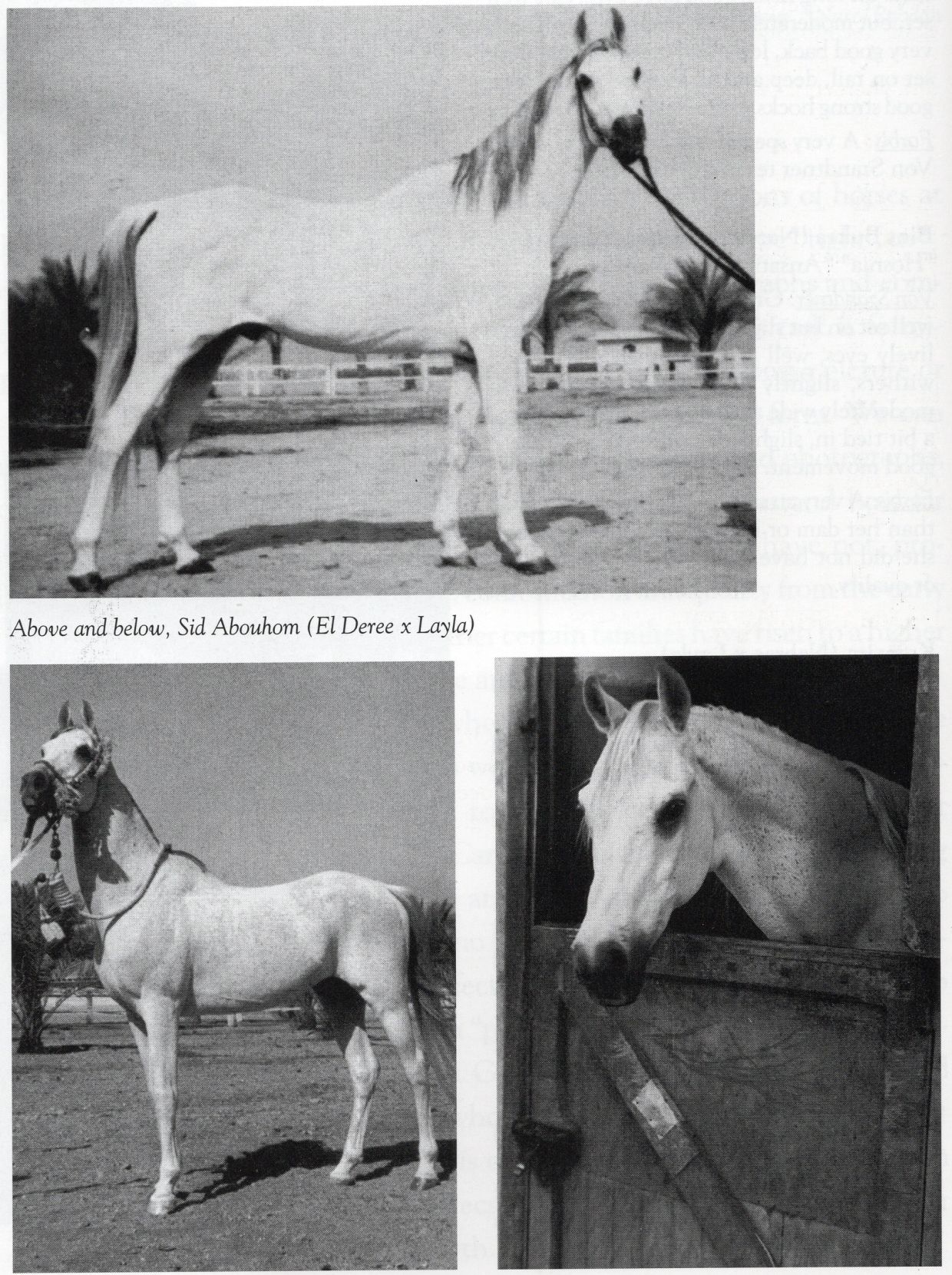
Sid Abouhom
mixed sources as noted:
The Greats of The Past: Farazdac & Iknatoon AHW 2/2023 - Domernico Tocchi; Translation Sonia Smaldone:
The grey Sid Abouhom (El Deree (INS) x Layla (RAS)) was a majestic stallion with high withers and a beautiful, well set and long-arched neck. His back was supple, and he had slightly strong loins, a good croup with a high tail carriage, chest of medium width, moderately deep and sufficiently broad. Despite some little faults, his legs were good, with big strong hocks which he promptly passed on to his progeny, with incredible movement and elegant gaits. Sid Abouhom had a noble head, well-set expressive eyes and small pointed ears.
From Authentic Arabian Bloodstock II (2003)
SID ABOUHOM (RAS) 1936 GS.........
Von Szandtner: Grey, Noble, noble head, good expressive eyes, very well set on small ears, very good set on nice long neck, good withers, forward stretching soft back, moderately strong loins, good croup, high set on tail, medium heart region, moderately deep, sufficiently wide, cannons moderately tied in, very little walkling on toe on the right front foot, moderately cut out hocks, very good movements, medium drawn in at knee, very little turned to the right hocks very good gaits, was a very good race horse.
Marsafi: Good. size and strength, long neck, not long-backed as Shahloul. Height hands compared to average size of 14.2; not as good a head as Shahloul; not very high tail carriage; very good racing. He bred in true and produced much better foals bred to Moniet El Nefous than Nazeer.
Forbis: Marsaf's comment above is questionable when one considers *Bint Moniet El Nefous, Maya, *Fakher el Din, who were comparable in quality and better conformed than those by Sid Abouhom; however, he may not have considered them as influential as breeding stock. We found Sid Abouhom to be a handsome very aristocratic horse even though he was in an emaciated state when we saw him just before he died. What impressed us most were his big dark expressive eyes in a handsome classic head with finely chiseled small ears, as well as his fine dry bone, prominent withers and extreme depth and layback of shoulder, He appeared well balanced even though gaunt. He was more "forehand" and a bit light in the rear (perhaps appearing that way due to age) with tendency to a lower croup, which most of his get had in comparison to those by Nazeer, Sid Abouhom's dam, Layla, was also a maternal half-sister to Sheikh El Arab (x Bint Sabah), another point most likely considered by the General in selecting him.
Ancestor of:
Agecroft Layla (Talika Farad x Talika Sirina bint Sirdahn)
Agecroft Ghayl (Greenmantle Ghashahn x Talika Sirina bint Sirdahn)
Khe Amin Tabou SSR (US) (Al Reyhan Marou x Anisa Gamal)
Ameer El Koloob (US) (Nour Al Kamar MH x DHS Tarah (IRE))
Ibb El Koloob (Ameer El Koloob (US) x Agecroft Layla)
Khofo
David Leaser - Fans of Gleannloch Arabians FB 2026
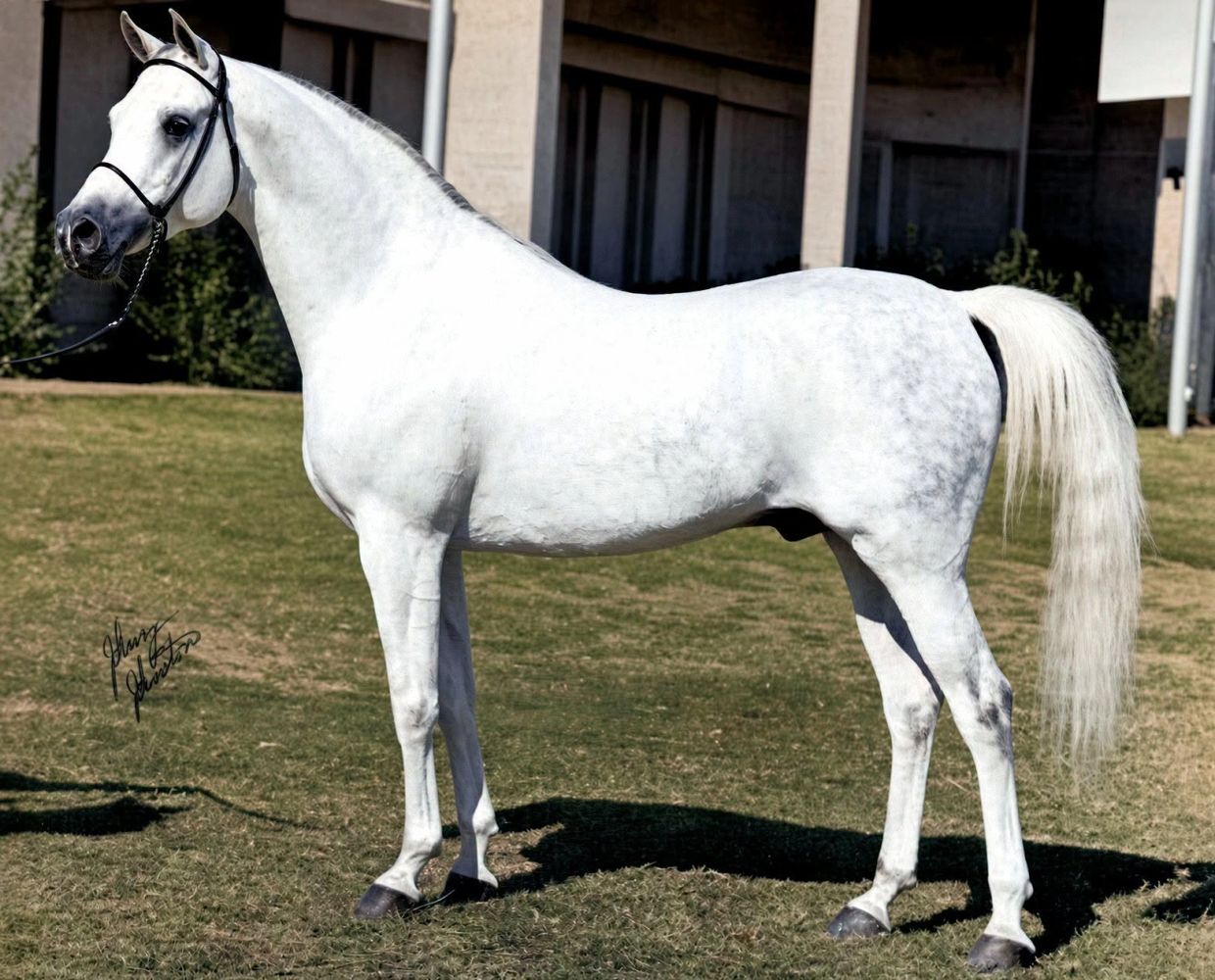
*Khofo++ (*Morafic x *Nabilahh) 1965 Grey Stallion
I first saw *Khofo++ at Hansi Heck’s Serenity Farms in Canada after *Serenity Sonbolah had won her national championship.
*Khofo++ was already alabaster white and incredibly beautiful. You could see *Morafic in his large, black, expressive eyes. He had a majesty about him.
After we acquired *Khofo++’s 7/8 brother, Wazir Ibn Morafic, I became friends with Hansi. She told me a few stories which she often shared with others, including how she acquired *Khofo++ from Gleannloch. According to Hansi, after she married in 1967, she and her husband, Bradford, were traveling through Texas when they passed Gleannloch and saw a grey colt in a grassy pasture. She told her husband to stop the car so she could see the young stallion. She then convinced him to drive onto the farm, where they met Doug Marshall and saw *Morafic. Like everyone, she was mesmerized by *Morafic.
But all Hansi could think about was *Khofo++. *Khofo++ was imported from Egypt by Gleannloch as a foal, alongside his mother, *Nabilahh (Anter x Farasha) and his famous father, *Morafic. According to Hansi, Mr. Marshall told her *Khofo++ was heir apparent to *Morafic and was not for sale. Hansi begged, Mr. Marshall said no, but then finally agreed to sell her *Khofo++. Perhaps he considered he owned both his sire and dam, so he could produce another. Indeed, *Nabilahh produced four more: Brothers Ben Morafic and Kamal Ibn Morafic and sisters, Bint Nabilahh and Lohelia.
Bradford and Hansi became close friends with the Marshalls and the McNairs. The following year, Tom and Rita McNair helped Hansi select additional horses from Egypt to breed to *Khofo++, including *Serenity Sonbolah. *Khofo++ was also bred to Gleannloch's *Magidaa (Alaa El Din x Maysa). Their daughter, Bint Magidaa, produced Ruminaja Ali, Alidarr and others.
In later years, I saw *Khofo++ a few more times when Hansi moved Serenity Farms to Florida. In his later years, *Khofo++ still had that tremendous presence and a sparkle in his large black eyes. Hansi would bring *Khofo++ right onto her lanai, just like a Bedouin would bring his horses into the tent. These horses were part of her family. And, in *Khofo++'s case, he was royalty. He knew it. Everyone did.
*Khofo++ sired more than 200 offspring. According to Hansi, more than half of them became international champions; no other Straight Egyptian stallion has ever accomplished this.
Jim Robbins writes:
Covering the bases of the recent and very successful Canadian Nationals Show and just one of the finest stallions of his time that could do it all, here’s *Khofo++ (Morafic x Nabilah by Anter) in a colorized yearbook shot from the master, Johnny Johnston. Bred by the EAO, foaled in 1965 and originally registered in Egypt as Khopho, *Khofo was imported as a foal and one of the first *Morafic sons in North America to take the world by storm. Brought in by Doug Marshall of Gleannloch Farms, he was sold to Hansi Heck right before his second birthday and would be with her until his death at the age of 26. What I loved most about *Khofo? He came from the era when Egyptian stallions could, and did, do it all with championships in Halter, Native Costume, English Pleasure and Western Pleasure. Nothing says Arabian like a well-rounded stallion.
*Morafic (Nazeer x Mabrouka by Sid Abouhom) as he was chief sire at the EAO for several years before his importation by the Marshall’s and his role in American, and world-wide, horse breeding knows no bounds. Nabilah (Anter x Farasha by Sid Abouhom), who became *Nabilahh after her importation to Gleannloch, came from the Hind (Ibn Rabdan x Bint Rustem by Rustem) branch of the Venus mare-line. Others with Hind as a tail-female include the full brothers *Faleh++ and *Farazdac (Alaa El Din x Farasha), the EAO herd sire Galal (Nazeer x Farasha), Om El Arab’s Shaker El Masri (Morafic x Zebeda by El Sareei) and Tersk’s great Aswan (Nazeer x Yosreia by Sheikh El Arab), just to name a few. In the US, there were several full siblings to the great *Khofo++ at Gleannloch, with a few of my favorites being Kamal Ibn Morafic, Ben Morafic who went to Canada and the mares Lohelia and Bint Nabilahh who were both great producing mares.
As a sire, *Khofo++ had an international influence that is still felt around the world. With 204 purebreds registered in the US, and probably another 20 or so in Canada, his breeding can still be found today. What gives him a world-wide flavor, is the fact that 4 of his daughters and 1 son were exported to Great Britain, the son *Serenity Habib (x *Serenity Bint Mamlouka by Mashhour) and an additional 2 sons and 1 daughter went to Germany, 3 daughters and the important breeding stallion *Khobiel (x Rivendell Czarina by Czarr) went to Uruguay, 2 daughters went to Argentina and *Serenity Habib went to Italy as an older stallion. Brazil is where the *Khofo legacy really showed, with the stallions *Serenity Mashalla (x *Serenity Shahara by Anter) siring 201 foals there, *Serenity Mashour (x *Serenity BintNoha by Nader) siring 60 foals and 12 additional *Khofo++ daughters heading to Brazil as well.
*Khofo’s daughters in the US were great producing mares as well, with Bint Magidaa (x Magidaa by Alaa El Din) being the most influential as she produced 7 full brothers by Shaikh Al Badi (*Morafic x *Bint Maisa El Saghira++), including US Reserve National Champion Stallion Ruminaja Ali, Ruminaja Bahjat, an important sire in the US and later for Count Zichy-Thyssen in Argentina, Ruminaja Fayez in the US and my personal favorite, *Alidaar, who sired foals around the world. Bint Magidaa also produced Thee Infidel (by Thee Desperado) and the full siblings *Thee Alchemist (by The Minstril), who was exported to Brazil and Miss Maggie Mae, an important breeding mare here in the US. Hansi bred many gorgeous *Khofo++ daughters out of *Serenity Sonbolah (by Sameh), the US National Champion Mare and her daughter, SF Sonbolah Tu (by *SF Ibn Nazeer), *SF Bint Mamlouka (by Mashhour) and *Galila (Ibn Galal x Gamila by Fayek), ensuring his blood bred on in SE programs. As an interesting side-note, Hansi also crossed *Khofo++ very successfully with daughters of some of the great CMK stallions, including Al-Marah Erka++, Shalimar Gidason, Crimson Bask (out of a Geym daughter) and the Gina Manion bred Tripple Ripple, with these mares producing some lovely daughters, many of which were exported.
I need to mention, as a sidenote to *Khofo’s story, that Hansi at any given moment was a brilliant horsewoman and breeder, hardheaded, strong, very opinionated, intelligent, self-righteous and I think at one point it was rumored that Jay Stream had a price on her head, after she published a series of books proclaiming that most US Arabians were “part-breds.”. This needs to be factored in, because had *Khofo++ been at a regular type farm he probably would have gotten a lot more mares to his court and been much more (deservedly) a sire of note.
Take a close look at this photo; great legs and feet, a short back and smooth body, lovely shoulder with great breed type and a large, low set eyes. You have *Khofo++, arguably one of the finest Egyptian stallions ever to set foot in Canada and later the US.
Ancesor of:
Agecroft Ghayl (Greenmantle Ghashahn x Talika Sirina bint Sirdahn)